Constitution Avenue and the Red Zone: a guide to Islamabad's government district
What lines Islamabad's grandest avenue, what the Red Zone and D-Chowk are, what visitors can and can't do there, and how closures affect traffic across the city.
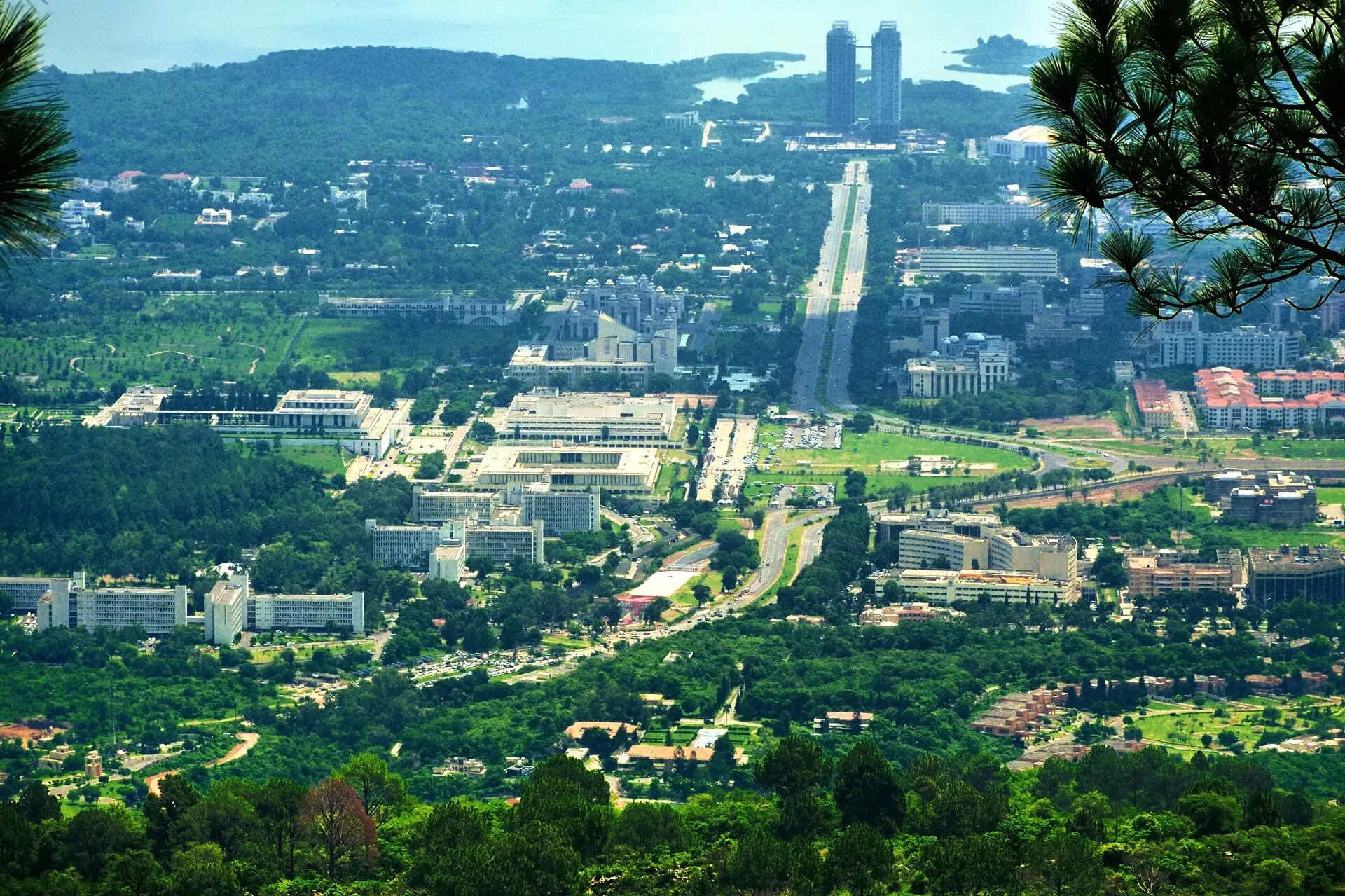 Photo: Zacharie Grossen, CC BY-SA 4.0
Constitution Avenue (Shahrah-e-Dastoor) is Islamabad’s grandest street. It crosses the eastern end of Jinnah Avenue, near the foot of the hills, and is lined with the buildings that run Pakistan: Parliament, the Supreme Court, the President’s House, the Prime Minister’s Office and the federal Secretariat. It is wide, tree-lined and immaculately kept, and it is also one of the most tightly guarded places in the country.
This guide explains what is on the avenue, what the Red Zone is, what you can do as a visitor, and why closures here can affect traffic across the whole city.
What lines the avenue
Driving along Constitution Avenue, you pass many of the country’s most important buildings:
- Parliament House, home of the National Assembly and the Senate.
- The Supreme Court of Pakistan, a white building with a striking modern design.
- Aiwan-e-Sadr, the President’s House.
- The Prime Minister’s Office.
- The Pak Secretariat, the complex of federal ministries, with the metro bus terminus nearby.
- Government offices and institutions on surrounding roads, with the Diplomatic Enclave, home to many embassies, close by.
The avenue’s design reflects the original plan for Islamabad: a formal, monumental government district set against the Margalla Hills, separate from the residential sectors.
What is the Red Zone?
The Red Zone is the high-security area around Constitution Avenue, the government buildings and the Diplomatic Enclave. Security here is much tighter than in the rest of the city:
- Checkpoints control access on roads leading in.
- Some roads are open only to authorised vehicles, especially near the Diplomatic Enclave.
- During protests, major events or official visits, the Red Zone can be sealed completely with containers and barriers.
What is D-Chowk?
D-Chowk (short for Democracy Chowk) is the large junction where Jinnah Avenue meets Constitution Avenue, close to Parliament. It is the traditional gathering place for political rallies and protests in the capital, and the site of some of the biggest sit-ins in Pakistan’s recent history.
When a large protest is announced, the authorities often close D-Chowk and the roads leading to it, and sometimes block entry points into Islamabad itself. That can cause traffic jams far from the Red Zone, on Jinnah Avenue, the Islamabad Expressway, Murree Road and the Srinagar Highway.
Can visitors go there?
Yes, you can usually drive along Constitution Avenue and see the buildings from the road when it is open to normal traffic. It is a beautiful drive, especially in spring and in the evening light.
But follow the rules:
- Don’t photograph security checkpoints, guards or sensitive buildings at close range, and never fly a drone. Ask a guard if you are unsure.
- Don’t stop or park in no-stopping zones along the avenue.
- Carry your ID (CNIC, or passport for foreigners). You may be asked for it at checkpoints.
- Follow police instructions at all times.
- Visiting Parliament or the Supreme Court requires official passes or invitations, which are arranged through the institutions themselves.
How Red Zone closures affect traffic
Closures in and around the Red Zone are one of the most common causes of traffic chaos in Islamabad. Typical knock-on effects:
- Jinnah Avenue and the Blue Area jam up when D-Chowk is closed.
- Metro bus services can be suspended during major security events.
- Entry points into Islamabad from Rawalpindi and the motorway are sometimes blocked during large protests.
- Mobile data is occasionally restricted in parts of the city during major unrest.
Before travelling on a day when a protest or big event is expected:
- Check Constitution Avenue traffic and Jinnah Avenue traffic on Discover Islamabad.
- Look at our live traffic map and any traffic alerts on the homepage.
- Follow official updates from the Islamabad Capital Territory Police and Islamabad Traffic Police.
- Allow extra time, and use alternative routes such as 7th Avenue and 9th Avenue.
Nearby places to visit
The government district sits close to some of Islamabad’s best green spaces and landmarks:
- Shakarparian and the Pakistan Monument, a short drive south.
- Lok Virsa Museum in Shakarparian.
- The Blue Area, for lunch. Read our where to eat guide.
- Rawal Lake, to the east.
In an emergency
If you see something suspicious, report it to the police on 15. For medical emergencies, call 1122. See all Islamabad helplines.